
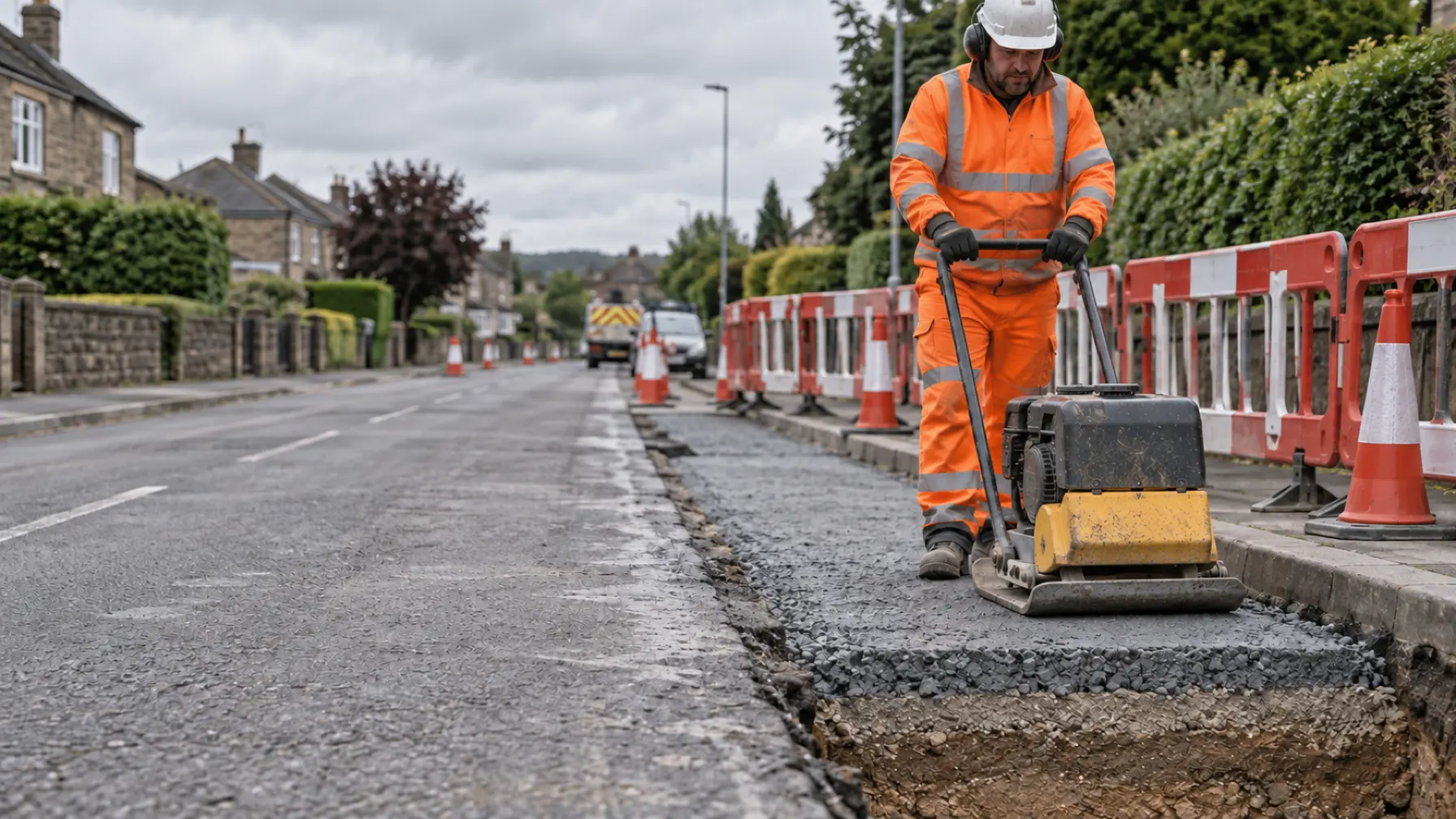
S3 — Monitoring Backfill & Compaction
Checking Backfill Materials
Question 1 of 10
0 correct 0 incorrect
Free S3 questions: Checking Backfill Materials
These questions are in the practice set above. Answer them there to see the correct option and the explanation for each.
- Scenario: a heavy clay dug out of the trench is offered for re-use as backfill. No liquid limit or plasticity index result has ever been obtained for it. The undertaker's engineer says he has worked this ground since he was an apprentice, that the clay "handles nothing like a high-limit clay", and that his own judgement puts it comfortably inside the limits SROH sets for clays. What should the supervisor decide?
- Scenario: Modified Type 1F Unbound Mixture is being used as backfill across a site and is performing well everywhere. In one phase of the works, though, site dumpers and the excavator itself will keep running directly over the backfill before the sub-base goes down. The crew wants to keep using the same Modified Type 1F there too, since it is the Code's preferred material. What should the supervisor decide?
- Scenario: a buried tree root has come out with the general spoil, so decomposed and crumbly that it breaks apart by hand and no longer looks or handles like solid timber. The crew wants to use the surrounding spoil, root fragments included, arguing "it's basically soil now, not really a log or stump anymore." What should the supervisor decide?
- Scenario: an undertaker proposes using foamed concrete (FCR) as the entire backfill layer in a footway trench, rather than as a partial supplement to granular backfill. The site engineer objects, believing FCR can only ever top up part of a layer alongside other backfill materials. What should the supervisor decide?
- Scenario: a Class A graded granular backfill material arrives on site. The crew checks it with field identification test No.2, the roll test used to judge clay condition, and finds it acceptable on that basis. What should the supervisor decide?
- Scenario: a Class C cohesive/granular backfill material tests at 30% granular content by mass. The crew checks it against the +1% to -2% of optimum moisture window, the same figure they used successfully on a Class B delivery earlier that day. What should the supervisor decide?
- Scenario: a delivery intended as Class A graded granular backfill passes its moisture check comfortably within +1% to -2% of optimum. The crew treats this as confirming the delivery is fully compliant Class A material and moves straight to placement. What should the supervisor decide?
- Scenario: the surround material being placed around a gas pipe is well-drained and free-draining overall, but contains occasional particles up to 40 mm nominal size. The crew argues that a few oversized pieces in an otherwise good material should not matter, and suggests the highway authority can be asked to rule on it if there is any doubt. What should the supervisor decide?
- Scenario: the undertaker proposes an approved alternative reinstatement material (ARM) for part of the surround to a length of apparatus, with a compliant hydraulically bound material (HBM) used for the rest. The site engineer believes the surround must be one uniform material throughout, and separately believes that where an alternative material is used at all, the remainder of the surround has to be ordinary granular fill rather than a second alternative. What should the supervisor decide?
- Scenario: an empty duct is exposed during backfilling. Its owner has confirmed in writing that the cable it once carried was fully removed some time ago and nothing remains inside it. No gas pipe runs within 300 mm of any part of the trench. The undertaker proposes encasing the duct in foamed concrete (FCR) along with the rest of the backfill. What should the supervisor decide?
13 questions on this topic in the app
Plus the rest of S3 — 48 questions in total — and a timed mock test you can retake as often as you like.


More free S3 practice
- Find It in the SROH — 3 free questions
NRSWA Revision: Street Works is independent revision material. It is not affiliated with, endorsed by or approved by HAUC(UK), SWQR, any awarding organisation or the Department for Transport, and it does not award a qualification or a card.